The median plumber earned $63,800 in May 2025, and the top 10% cleared $108,420, according to the U.S. Bureau of Labor Statistics. Those numbers describe people working for someone else.
Owners who run their own trucks and set their own rates can do better, but only after clearing the licensing, insurance, and cash-flow hurdles that sink a lot of new shops in year one.
So what does it actually take to go from journeyman to owner in 2026?
Key takeaways
- Most states require a license to work as a plumber, and you usually climb from apprentice to journeyman to master before you can pull permits and run a shop. A few states (Kansas, Wyoming, Missouri) leave licensing to cities instead.
- Housecall Pro puts plumbing startup costs at $10,000 to over $50,000, mostly the work truck and equipment. ZenBusiness gives a wider span, from $5,000 for a small home-based shop to $100,000 for a larger one with employees and several vehicles.
- The U.S. plumbers industry was worth $208.1 billion in 2026, growing at a 4.9% compound annual rate since 2021 (IBISWorld). There is room for one more truck.
Starting a plumbing business comes down to seven steps:
- Get licensed: apprentice, then journeyman, then master, with rules that vary by state.
- Budget for the launch: $10,000 to over $50,000, mostly the work truck and equipment.
- Set up the company: form an LLC and get your EIN.
- Insure and bond it: general liability, plus a surety bond where your state or city requires one.
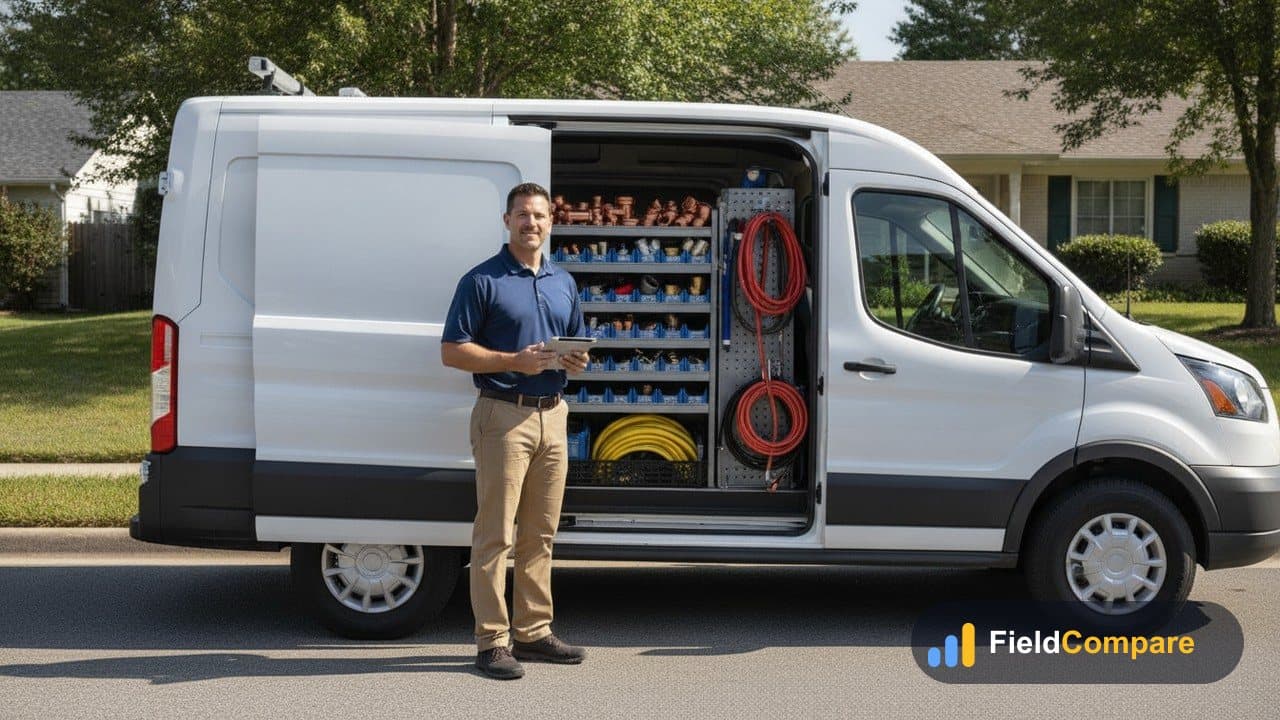
- Equip the van: a used cargo van, tools, and stocked fittings.
- Price jobs and find customers: cover your loaded cost, then use your network, a Google Business Profile, and reviews.
- Put software behind scheduling and invoicing: it saves billable hours before you hire.
What does the plumbing market look like in 2026?
The U.S. plumbers industry hit $208.1 billion in revenue in 2026, up 0.5% for the year, with a 4.9% compound annual growth rate since 2021 (IBISWorld). Roughly 129,000 plumbing businesses employ over 742,000 people nationwide (Simpro, citing IBISWorld).
That is a big, fragmented market. Most of it is small operators, which is exactly the gap a new one-truck shop fills.
By occupation, BLS counts 510,600 plumbers, pipefitters, and steamfitters, and 65 percent work for plumbing, heating, and air-conditioning contractors. About 8 percent are self-employed, roughly 40,800 people.
BLS projects 7 percent growth from 2025 to 2035, with about 42,000 openings a year.
Demand holds up because pipes fail on their own schedule. Aging housing stock, water heaters that die on a Sunday, and slab leaks do not wait for a good economy. That steadiness is why plumbing pay sits above a lot of the trades.
What license do you need to start a plumbing business?
Most states require a plumbing license to work at all, and some make you hold a master license before you can get a plumbing contractor’s license, which lets you pull permits and run a company. The path runs in three steps.
Skip a rung and you cannot legally do the work you are billing for.
Apprentice to journeyman to master
You start as an apprentice under a licensed journeyman or master, and that stretch usually lasts four to five years. A journeyman license typically takes around 8,000 hours (roughly four years) plus a passing exam, and it lets you work on your own.
The master license sits on top: one to three more years of experience and a harder test, and it is the credential that lets you supervise journeymen, pull permits, and own a plumbing business (ServiceTitan).
BLS says most plumbers learn through a 4- or 5-year apprenticeship with about 2,000 hours of paid on-the-job training a year, and that some states require master status to hold a plumbing contractor’s license.
Rules vary hard by state. New York City wants seven years toward a master license.
A handful of states, including Kansas, Wyoming, and Missouri, have no statewide plumbing license and hand the job to individual cities. Check your state board before you spend a dollar on anything else.
How much does it cost to start a plumbing business?
Plan for $10,000 to over $50,000, depending on where you work, the size of your operation, and whether you buy new or used equipment (Housecall Pro).
ZenBusiness gives a wider span: $5,000 for a small home-based shop up to $100,000 for a larger one with employees and multiple vehicles.
The single biggest line is almost always the truck. Everything else scales with how fast you want to grow.
Where the money goes
The work truck is the biggest line at $10,000 to $50,000, depending on the size of your operation and whether you buy new or used (Housecall Pro).
Housecall Pro budgets $5,000 to $15,000 for equipment and supplies, and says basic tools alone run $1,000 to $5,000. It suggests buying used tools, renting specialized ones, and using supply-house credit lines to hold the cost down.
Marketing and branding runs $1,500 to $5,000, and initial operating expenses such as transportation, uniforms, and small tools run $1,000 to $3,000.
| Line item | Typical cost | Notes |
|---|---|---|
| Work truck | $10,000 to $50,000 | New or used, depending on the size of the operation |
| Equipment and supplies | $5,000 to $15,000 | Basic tools alone: $1,000 to $5,000 |
| Marketing and branding | $1,500 to $5,000 | Listed as one line by Housecall Pro |
| Insurance | $1,000 to $4,000 | General liability alone averages $1,045 a year (MoneyGeek) |
| Initial operating expenses | $1,000 to $3,000 | Transportation, uniforms, small tools |
| Licensing and permits | $80 to $420 | Surety bonds are covered below |
Source: Housecall Pro, How to Start a Plumbing Business (page modified January 8, 2026), retrieved October 1, 2026. The insurance note is from MoneyGeek (updated September 12, 2026).
How do you set up the business legally?
Form an LLC first. It separates your house and savings from a job that goes wrong, though Housecall Pro notes it carries higher fees than a sole proprietorship.
Then line up three things before you take a single call: insurance, a surety bond where your state or city requires one, and your EIN for taxes and payroll.
Insurance and bond
General liability insurance for a solo plumber averages $87 a month, or $1,045 a year (MoneyGeek, updated September 12, 2026). A starter bundle for one van, adding commercial auto, tools and equipment coverage, and a surety bond, averages $343 a month.
Commercial auto averages $205 a month, or $2,458 a year, per work vehicle. Once you hire, workers compensation averages $276 a month per employee, or $3,309 a year, for a crew of one to four (MoneyGeek).
Many states and cities also make you post a surety bond to hold a contractor license. Bond amounts typically range from $3,000 to $25,000 (Lance Surety Bonds). California requires $25,000 (state licensing board), and Washington $15,000 for specialty contractors (Labor and Industries).
The yearly premium is typically 1% to 5% of the bond amount (Lance Surety Bonds).
Credit decides where you land: Lance’s example for a $25,000 Minnesota plumbing bond runs from $188 to $375 a year with a 700-plus score to $1,250 to $2,500 below 599.
The bond protects your customer, not you, so budget for it as a cost of doing business.
How should you price jobs and land your first customers?
Price to cover your fully loaded cost per hour, not just your wage. Add up insurance, van payment, fuel, software, and the hours you spend quoting and driving, then divide by billable hours to find your true break-even rate.
Flat-rate pricing per job usually beats hourly for residential work because it removes the customer’s fear of a ticking clock and rewards you for being fast.
Our guide to how to price a plumbing job walks through the formula, with labor costs from BLS data.
To run your own numbers, use our plumbing pricing calculator.
For the first customers, lean on the network you already have. Tell every general contractor, real estate agent, and property manager you know that you are open.
Claim a Google Business Profile the same week you launch, because local search is where most emergency plumbing calls start.
Ask for a review after every clean job. Reviews are the cheapest marketing a new plumber will ever buy.
What software runs a one-truck plumbing business?
A solo shop can run on field software that handles scheduling, dispatch, quoting, and invoicing.
Doing that work by hand costs you billable hours and lost tickets. The right tool depends on how big you plan to get.
For a lean owner-operator who wants clean quotes and fast mobile invoicing, Jobber and Housecall Pro are the usual starting points, and both scale to a small crew.
Jobber Core costs $29 a month billed annually ($49 with no commitment), and Housecall Pro Basic costs $59 a month billed annually ($79 billed monthly), both checked October 1, 2026.
Disclosure: FieldCompare may earn a commission if you buy Jobber or Housecall Pro through links on this page. It does not change the prices above.
If you already picture a fleet with call-center-grade dispatch and detailed reporting, ServiceTitan is built for that scale, though it is heavier and quote-only on price. Service Fusion sits in the middle for shops that want flat-rate pricing books without enterprise complexity.
If you want the side-by-side, our roundup of the best plumbing software breaks down who each tool actually fits.
Frequently asked questions
Do I need a master plumber license to own a plumbing business?
In some states, yes. BLS says some states require master plumber status to get a plumbing contractor’s license, and a master license typically takes one to three years of experience beyond your journeyman and a harder exam (ServiceTitan).
A few states leave the rules to individual cities, so confirm with your local board.
Can you start a plumbing business without being a plumber?
It depends on the state. BLS says most states require a license to do plumbing work, and some require master plumber status for a plumbing contractor’s license. Confirm the rules with your state or local board before you hire or file anything.
How much money do I need to start a plumbing company?
Housecall Pro puts startup costs at $10,000 to over $50,000, mostly the work truck ($10,000 to $50,000) and equipment ($5,000 to $15,000). ZenBusiness gives a wider span, from $5,000 to $100,000.
Add cash for the first slow months, since customers pay slowly and insurance, bond, and software come due first.
Is owning a plumbing business profitable?
It can be. Plumbing businesses sold on BizBuySell from 2021 to 2025 had median owner earnings of $311,598 before tax and debt, but that covers only companies big enough to sell.
IRS data puts the average net margin of incorporated plumbing and HVAC contractors at 5.7 percent for 2022 (VantaInsights), so profit depends on pricing and overhead.
How much can a plumbing business owner make?
Employed plumbers earn a median of $63,800, with the top 10% above $108,420 (BLS, May 2025). Our full guide to how much plumbers make breaks that down by hour, experience level, and state.
Owners can earn more because they keep the margin on every truck, but that upside only shows up after you cover general liability insurance averaging about $1,045 a year, a van payment, and payroll if you hire.
Our plumbing business owner salary guide breaks owner earnings down by company size, from solo shops to companies that sell.
Is plumbing a growing field?
Yes. The U.S. plumbers industry reached $208.1 billion in 2026 with a 4.9% compound annual growth rate since 2021 (IBISWorld), and BLS projects 7 percent employment growth from 2025 to 2035, much faster than average.
Aging housing and constant emergency repairs keep demand steady.
How much should I keep in cash before I launch?
Beyond your startup costs, keep enough cash to cover personal and business bills through the slow first months. Customers pay slowly, and your first month of insurance, bond premium, and software comes due before your invoices clear.
The bottom line
Starting a plumbing business is less about the trade and more about the paperwork and the math around it. You already know how to fix a leak.
The work now is getting the master license your state expects, funding a van and tools without going broke, and pricing jobs to actually clear a profit after insurance and bond.
Get those three right, put cheap software behind your scheduling, and a one-truck shop is a realistic path in a $208 billion market.
Before you buy the van, write the numbers down. Our plumbing business plan guide lists the sections to include and shows how to work out break-even.
Sources
- U.S. Bureau of Labor Statistics, Occupational Outlook Handbook, Plumbers, Pipefitters, and Steamfitters (median $63,800, May 2025; 510,600 jobs, 65 percent in plumbing, heating, and air-conditioning contractors, 8 percent self-employed; 7 percent growth and about 42,000 openings a year, 2025 to 2035; 4 or 5 year apprenticeship; page modified August 27, 2026), retrieved October 1, 2026, bls.gov
- IBISWorld, Plumbers in the US market size report, retrieved August 29, 2026, ibisworld.com
- Simpro, Plumbing Industry Statistics 2026 (about 129,000 businesses and over 742,000 employees, citing IBISWorld; published June 9, 2026), retrieved October 1, 2026, simprogroup.com
- Housecall Pro, How to Start a Plumbing Business (startup cost breakdown, $10,000 to over $50,000; tools budget; page modified January 8, 2026), retrieved October 1, 2026, housecallpro.com
- MoneyGeek, Average Plumbing Business Insurance Cost 2026 (general liability $87 a month, starter bundle $343, commercial auto $205, workers compensation $276; updated September 12, 2026), retrieved October 1, 2026, moneygeek.com
- ServiceTitan, Plumbing License Requirements by State (journeyman and master timelines, states without a statewide license, New York City; updated June 30, 2026), retrieved October 1, 2026, servicetitan.com
- ZenBusiness, How to Start a Plumbing Business (startup costs from $5,000 to $100,000; updated June 8, 2026), retrieved October 1, 2026, zenbusiness.com
- Lance Surety Bonds, Plumbing Bond (typical amounts $3,000 to $25,000, premiums 1 to 5 percent, Minnesota $25,000 bond example), retrieved October 1, 2026, suretybonds.org
- California Contractors State License Board, Bond Requirements (contractor’s bond $25,000 since January 1, 2023), retrieved October 1, 2026, cslb.ca.gov
- Washington Department of Labor and Industries, Register as a Contractor ($15,000 surety bond for specialty contractors), retrieved October 1, 2026, lni.wa.gov
- BizBuySell, Plumbing Business Valuation Benchmarks (median owner earnings $311,598 for businesses sold 2021 to 2025), retrieved October 1, 2026, bizbuysell.com
- VantaInsights, HVAC and Plumbing Business Profit Margins (5.7 percent net margin, IRS Statistics of Income corporate returns, 2022), retrieved October 1, 2026, vantainsights.com
- Jobber, Pricing (Core $29 a month billed annually, $49 with no commitment), retrieved October 1, 2026, getjobber.com
- Housecall Pro, Pricing (Basic $59 a month billed annually, $79 billed monthly), retrieved October 1, 2026, housecallpro.com